We Use What Works. Nothing Else.
Five techniques out of seventeen. Advanced equipment when it helps. No treatment just because it's trendy.

The Approach
Most chiropractors learn a technique in school and use it for the rest of their career. Same adjustment. Same protocol. Every patient gets the same thing whether it works for them or not.
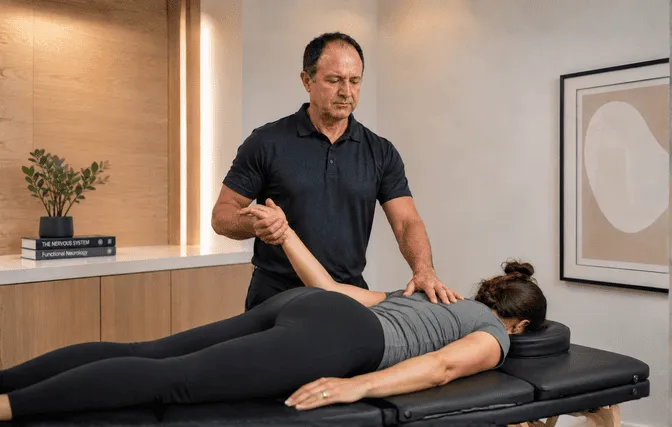
That's not how bodies work.
Over 22 years, I've learned 17 different techniques. I use five of them. Not because I forgot the other twelve, but because I figured out which ones actually get people better.
We use muscle testing to let your body tell us what's wrong. Then we use the right tool for the job. Sometimes that's neurologic work. Sometimes it's structural. Sometimes it's opening drainage pathways. Usually it's a combination.
The goal isn't to see you three times a week forever. The goal is to fix the root problem so it stays fixed.
Our Primary Techniques
These are the foundation of what we do. About 95% of our work starts here.
Neural Integration (NIS)
Your brain controls everything. When it can't, you hurt.
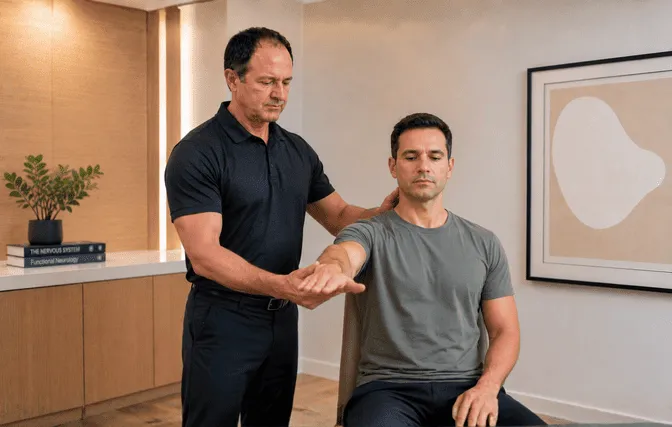
NIS uses muscle testing to find where your brain isn't regulating your body properly. We test every muscle, every organ reflex, every cranial point. Then we reset those neurologic patterns.
This isn't about moving bones. This is about restoring the communication between your brain and your body. When that works correctly, pain goes down, inflammation drops, immune function improves, and your body heals the way it's supposed to.
Good for:
Chronic pain that won't respond to regular adjustments
Immune system problems
Digestive issues
Stress and anxiety patterns
Inflammation that won't go away
Headaches and migraines
What to expect: Low-force. No cracking. We're working with your nervous system, not forcing bones around.
Zone Technique
Six systems. One is stressed. We find which one.
Your body has six control systems: glandular, elimination, nervous, digestive, muscular, and circulation. When one of those systems gets stuck in stress mode, your entire body compensates.
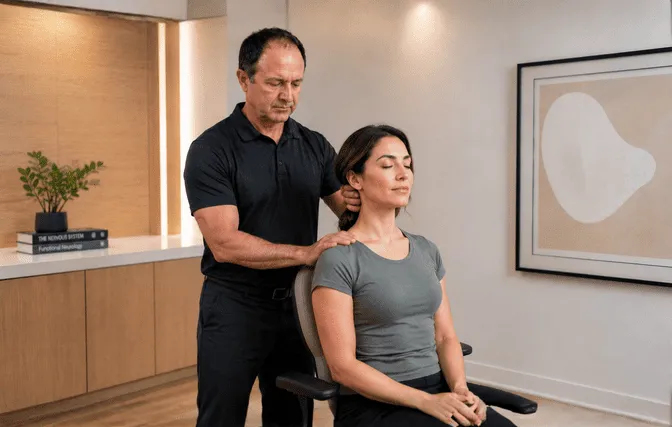
Zone Technique works through the vagal nerve to reduce your fight-or-flight response. We figure out which zone is causing the problem and bring it back to balance.
Think of it like a circuit breaker that keeps tripping. You can reset it all day, but until you fix what's overloading the circuit, it'll just trip again. Zone Technique fixes the overload.
Good for:
Anxiety and stress responses
Sleep problems
Digestive issues
Chronic tension
Recovery from illness or injury
Hormonal imbalances
What to expect: Gentle pressure on specific points along your spine. Most people feel more relaxed immediately.
KST (Koren Specific Technique)
You hurt yourself doing something. We fix you in that position.
Nobody hurts themselves lying on a treatment table. You hurt yourself sleeping, shoveling snow, playing golf, sitting at a desk, or doing something specific.
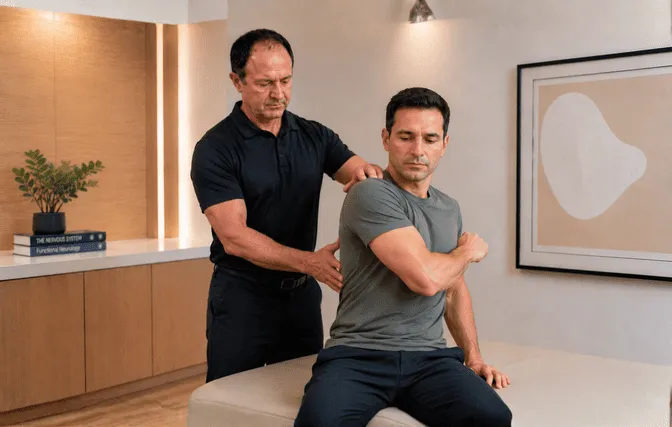
KST is position-specific adjusting. We put you in the position that breaks you and use muscle testing to find exactly where your body is failing. Then we adjust you there, in that position, so your body learns to handle it correctly.
We use a low-force instrument called an ArthroStim. No cracking. Just precise corrections where your body actually needs them.
Good for:
Pain in specific positions or activities
Sports injuries
Repetitive strain
"I can't sleep on my left side" problems
"My back goes out when I..." issues
Chronic problems that keep coming back
What to expect: We'll ask you to demonstrate the movement or position that hurts. Then we'll work on you in that position. Most people are surprised how much more effective this is than lying flat on a table.
Advanced Rehabilitation & Therapies
Sometimes the nervous system work isn't enough. Sometimes you need equipment that helps your body heal faster or addresses chronic problems at a deeper level.
Emsculpt Neural Rehabilitation
For chronic pain that won't respond to anything else.
When you have an injury in your low back, neck, or shoulder, the deep stabilizing muscles get infiltrated with fat and scar tissue. Even with physical therapy, those muscles can't fire properly because the electrical signal from your brain can't get through the fat.
Emsculpt uses radiofrequency and an MRI-level magnet to:
Fire the muscle thousands of times (bypasses the brain-body connection problem)
Burn out the fat infiltration with RF heating
Rebuild the muscle so it can stabilize properly
We trained under a neurosurgeon to do spinal settings on this machine. This isn't the cosmetic version you see advertised for abs. This is neural rehabilitation for chronic pain.
Good for:
Chronic low back pain.
Chronic neck pain.
Shoulder problems that won't heal.
When you're not surgical yet, but getting close.
When physical therapy didn't work.
What to expect: 30-minute sessions. Feels like an intense workout. Series of four treatments minimum. Available at Bozeman location only.
Investment: $4,000 for four-session series per body area. Financing available through Cherry.
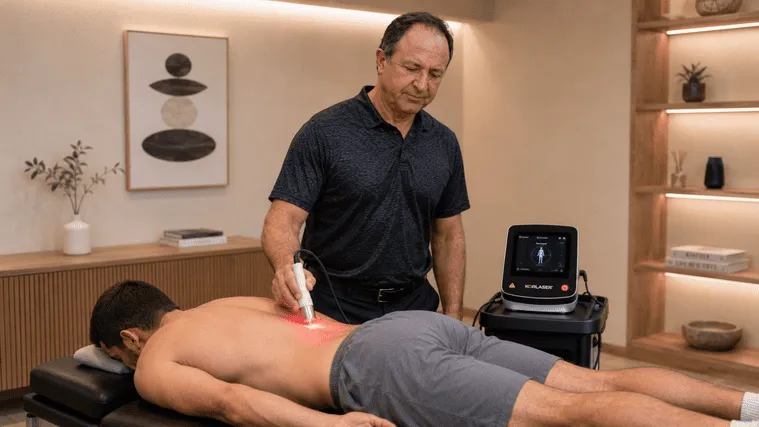
Cold Laser Therapy
Heal up to 12 times faster.
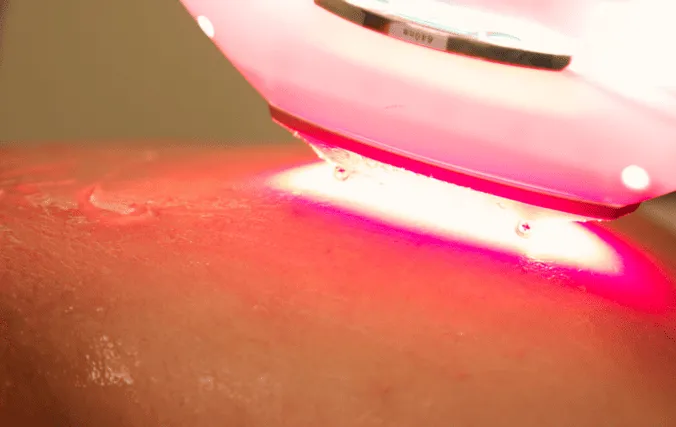
Cold laser (low-level laser therapy) speeds up cellular healing. It reduces inflammation at the neural level, decreases pain, and helps damaged tissue repair faster.
We use it for acute injuries, post-adjustment healing, nerve pain, and chronic inflammation that won't respond to other treatments.
Good for:
Acute injuries.
Nerve pain.
Post-surgical healing.
Chronic inflammation.
Headaches.
Any injury that's healing too slowly.
What to expect: 5-15 minute treatment. You'll feel warmth. No pain. Often combined with adjustments.
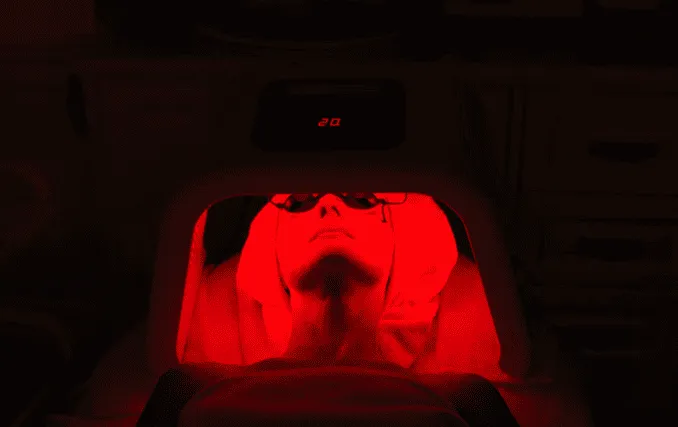
Full Body Red Light Therapy
For whole-body inflammation and chronic conditions.
This is different from the cold laser. Full body red light addresses systemic inflammation throughout your entire body.
Chronic inflammation holds onto water weight as a buffer. Most people notice they lose a couple inches after treatments, not because they lost fat, but because their body finally let go of inflammatory water retention.
Good for:
Chronic inflammation
Autoimmune conditions
Water retention
Systemic pain
Recovery support
What to expect: Stand or lie under red light panels for 10-20 minutes. Relaxing. Many patients fall asleep.
Supporting Therapies
These aren't standalone treatments. They support the primary work and help your body maintain the changes we make.
Kinesio Taping
Helps your brain remember the correct movement patterns.
After we adjust you, we sometimes use kinesio taping to reinforce proper movement. The tape gives your brain constant feedback about how the area should move. This helps the adjustment hold longer and trains your body to maintain correct patterns.
When we use it:
After first adjustments to reinforce patterns.
For athletes returning to activity.
When you need support between visits.
To retrain movement patterns.
Lymphatic Drainage
All chronic pain involves your lymphatic system.
That's not an exaggeration. If your lymphatic system isn't draining properly, you're going to stay inflamed and stay in pain.
We do manual lymphatic work at the base of the skull and throughout the body to open up drainage pathways. This is especially important for people with chronic pain, autoimmune conditions, or toxic burden.
When we use it:
Chronic pain cases
Headaches and migraines
Post-injury swelling
Toxic burden
Autoimmune conditions
Cranial Work
Your skull bones move. When they don't, you hurt.
We do cranial reflex testing and gentle cranial adjustments to restore proper movement and cerebrospinal fluid flow. This isn't traditional craniosacral therapy. This is specific cranial corrections based on what your nervous system needs.
When we use it:
Headaches
TMJ problems
Concussion recovery
Brain fog
Sensory processing issues
Somatics & Emotional Release
Your fascia stores emotion. Sometimes you need to release it.
Somatics involves putting your body in specific positions and breathing into points of pain or restriction. This releases emotions stored in the fascia.
Sounds weird. Works well. Especially for people whose pain has an emotional or traumatic component.
When we use it:
Pain with emotional components
Trauma history
Chronic tension that won't release
When the physical work isn't enough
Functional Medicine
Sometimes the problem isn't your spine. Sometimes it's what's in your gut, your cells, or your environment.
We added functional medicine after our daughter got sick and the medical system had no answers. We learned how to test for and treat the things most doctors never look for.
We Address:
Parasites

Heavy Metals

Mold Toxicity

Chronic Infections
Food Sensitivities
Gut Dysfunction
Toxin Burden
Testing Available:
Comprehensive Blood Panels

Allergy and Sensitivity Testing

Stool Analysis
Autoimmune Panels
OAT (Organic Acids Test)
MDX Longevity Testing

Hair Tissue Mineral Analysis
Our approach: Get the crap out. Open your drainage pathways. Address root causes. Not symptom management with herbs.
This is a whole separate conversation. If you're dealing with chronic illness, gut problems, or conditions that aren't responding to anything, functional medicine might be where we start.
How We Decide What You Need
First Visit:
We test everything. Every muscle. Every reflex. Gait patterns. Cranial points. Zone assessment. Your body tells us what's wrong through muscle testing.
Then we correct only 3-4 patterns on the first visit. We start slow to see how your brain responds.
Follow-Up Visits:
If you responded well, we go deeper and faster. If you felt like you got hit by a truck, we slow down. We add structural work, equipment, or functional medicine support based on what your body needs.
The Goal:
Fix the root problem. Not manage symptoms. Not see you three times a week forever. Get you better, then let you decide if you want to stick around for wellness care.
Average acute care is six visits | Some people need two | Some need twelve | Depends on severity and how long you've had the problem.
What We Don't Do
We Don't:
Adjust every patient the same way.
Force bones around hoping they stay.
Sell long-term care contracts.
Chase symptoms with temporary fixes.
Use every new technique just because it's trendy.
Take insurance (but we give superbills for reimbursement).
Pretend we can help everyone (if we can't help you, we'll tell you).
We Do:
Use muscle testing to find root causes.
Combine techniques based on what you need.
Give honest timeframes for results.
Charge per visit ($45-65).
Tell you if you need something we don't offer.
Keep learning and updating our approach.
22 Years in Practice
Low-Force Approach
Average 6 Visits for Acute Care
No Long-Term Contracts
Not Sure Where to Start?
Book your first visit. We'll test everything, figure out what's actually wrong, and tell you which services will help. You don't need to know the names of the techniques. You just need to show up.
Most people feel at least some improvement within the first few visits. If you're not, we adjust the approach. Your body will tell us what it needs.
Livingston Location
Chiropractic & Functional Medicine:
Mondays: 8am-12pm; 2pm-6pm
Wednesdays: 8am-12pm; 2pm-6pm
Thursdays: 8am-12pm
Bozeman Location
Chiropractic & Functional Medicine:
Tuesdays: 9am-12pm; 3pm-6pm
Fridays: 9am-12pm
Emsculpt & Advanced Therapies:
Mondays: 9am-6pm
Wednesdays: 9am-6pm
Thursdays: 9am-6pm
© Copyright 2026 | All Rights Reserved | Terms & Conditions